I've got to admit, I'm quite disappointed, simply because very close to this discussion I had found possibly the most interesting and applicable reading(s) I've found to date:
Carson, D. (2000) Gamasutra, Environmental Storytelling: Creating Immersive 3D Worlds Using Lessons Learned from the Theme Park Industry. [Online] Available at: http://www.gamasutra.com/view/feature/3186/environmental_storytelling_.php [Accessed: 23 October 2012].
Carson, D. (2000) Gamasutra, Environmental Storytelling, Part II: Bringing Theme Park Environment Design Techniques to the Virtual World. [Online] Available at: http://www.gamasutra.com/view/feature/131593/environmental_storytelling_part_.php [Accessed: 23 October 2012].
I literally want to be this guy.
He talks about practically everything I was trying to convey in my last post, and more - but never mind: rethinking is for the best. Perhaps The readings will come in useful at some point.
---
Anyway; the new direction of my project is still in the direction of a Unity game - but instead of focusing on mainly theme, it will be on code.. for this reason; most (but not all) of my readings have changed;
 Goldstone,W., 2009. Unity Game Development Essentials. Packt Publishing.
(Previous Readings)
This book looks very useful as it covers all aspects of Unity in good detail. HUD creation and object collection in chapter 5, particle systems in chapter seven... Actually, Yeah; I am definitely going to read through large parts of this book as I believe it provides a good groundwork of some of the main aspects of unity I may not know so much about.
Additionally, while Googling for the picture on the left, I found an Ebook called "Unity 3.x Game Development Essentials" by the same person. From what I've read, it seems to be an updated and expanded version of the book for the newer versions of unity.
Goldstone,W., 2011. Unity 3.x Game Development Essentials. Packt Publishing.

Mernard, M., 2011. Game Development with Unity. Course Technology PTR.
(Previous Reading)
I borrowed this book from Ross temporarily (he needed it more than me and there was only one copy) this book is very good as it covers making games in unity as a whole; this means it goes from concept, to working around unity, scripting, UI, particles, music and more. I may not need some early chapters in the book, but I have a feeling I will need most of the later ones.
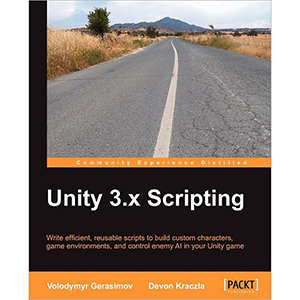 Gerasimov, V., Kraczla, D, 2012. Unity 3.x Scripting. Packt Publishing.
This book is by the same publisher as the ones by Goldstone, so I'm hoping it's going to be just as good. From what I've read, it seems to require some previous understanding of unity scripting (or at least how to start-up with unity scripting) so it may benefit me to read some of the more basic books I have found before reading this one. Chapter four, depending on exactly what I want to do may prove very helpful as it covers inventorys in unity. Other areas of interest are GUI, and AI. How much I can use may be limited form this book as it seems it makes a fps shooter, which is very far from what I'm planning to make.
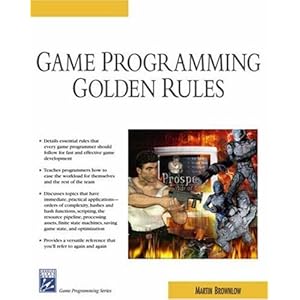
Brownlow, M., 2004.Game Programming Golden Rules.Charles River Media.
I picked up this book instantly as it seemed just what I needed. This book is full of tips for coding. unfortunately most of it is not for the languages I use and/or it is for far more complex things such as projects you code from scratch (instead of using a unity engine or other such things) I'm kind of disappointed but I'm pretty sure I can find something which will benefit me in this book.
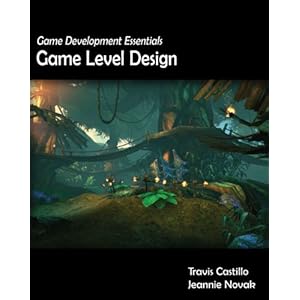 Castillo,T., Novak,J., 2008.Game Development Essentials: Game Level Design. Delmar Cengage Learning.
I got this book for my old project idea, but it covers all aspects of level design and the thought and concept progress, so although it may not be as applicable as it used to be, the early chapters (1-3) for concepting and designing should be of use.
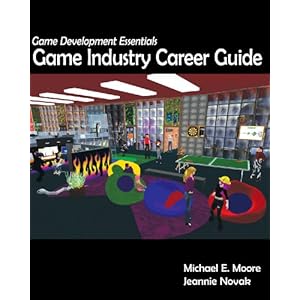 Moore, M., Novak,J., 2008.Game Development Essentials: Game Industry Career Guide. Delmar Cengage Learning.
I got this book because I was on about how I had not much of an idea of what i wanted to do when I'd finished uni and the good thing is it should be useful for whatever I decide to do for my dissertation - and perhaps improve it in the areas I need to in order to get a job.

This seems like a fantastic read which would go well, or help vastly with almost any game design project; This book as some great insight into how to make a game fun to play and how to polish a game very well. chapter 14 may also be very useful for our group project this year. Most of the book interests be including but not limited to inputs, responses, mechanics and polishing.
I think it may actually help improve my games, rather than just expand my knowledge; which I think is probably a good thing.
Adams, E. (2011) Gamasutra,The Designer's Notebook: Eight Ways To Make a Bad Tutorial [Online] Available at: http://www.gamasutra.com/view/feature/134774/the_designers_notebook_eight_.php? [Accessed: 31 October 2012].
I plan to do a game which gently eases players into several retentively new mechanics, progressing in difficulty; people always seem deluded that a good tutorial is an easy thing to do, but it clearly isn't judging by all the flash games I've played in the past. This reading should be a good guide for doing a good tutorial; or at least what not to put in a tutorial; which is a good start.
Anyway; My new dissertation proposal is a 2D rendered puzzle game in unity - The basics of the concept is to transfer "energy" (whatever it may be) from one side of the screen to the other using wires. There will be several things stopping you from doing this; the first will be the lengths of wires given to you. This means you will have to go through several "stations" along the way in order to reach your goal. the second thing stopping you will probably be "station" size or capacity; this means you'd have to split your "energy" through different stations and regroup it at the other side. Although the mechanics are a little sketchy at the moment, they are a lot more solid than what I had before. other related mechanics might be colour coded wires/stations, "energy" transformers/reducers, and other ways of transferring "energy" from one place to another.
What sets aside this idea from the other is that it is highly code based; it gives me the chance to deepen my knowledge in code while making an interesting concept and/or a game.
This concept derived from a simplification of a few mechanics that I found elsewhere;
the first was from a game called crazy machines: crazy machines is a puzzle based Rube Goldberg game; you can use pretty much anything to solve an incomplete Rube-Goldberg machine. my focus was the electrical components,as you simply drag and drop plug sockets from one place to another in order to link them. It's an interesting concept but it's a minor part of the game which hasn't been explored to its maximum potential.
 |
| Crazy Machines: Wire component of the game. |
The second spurt of inspiration was from programs that use Node editors; primarily UDK texture editor and FilterForge editor;
 |
| Example of UDK node texture editor |
 |
| Stylised version of the filter forge node editor. |
The third and final inspiration for a node game is from the flash game "tentacle wars"; the aim of tentacle wars is to manage the size of your tentacles by connecting them and fight off the opponent; the fighting is irrelevant to me, but the mechanic of dragging connections and transferring a form of energy is.
 |
| Tentacle Wars |
Anyway, this post is far bigger than I originally planned, So I'll stop otherwise nobody will read it.

I certainly think that it is a wise move to have a dissertation which focusses on the coding aspect of unity. As I have said a number of times you really want your dissertation to demonstrate 'depth' this tells potential employers that you are able to push yourself. You have said the code would be hard, can you be a little more explicit here about what the challenges will be for you in this area. This will help you to draw up a reasonable timeline for the project as it will show us what specific skills you are seeking to master.
ReplyDeleterob